CatalystAgent · AN AI VIRTUAL PHARMA FOR R&D TEAMS

Drug-discovery decisions,
built on evidence

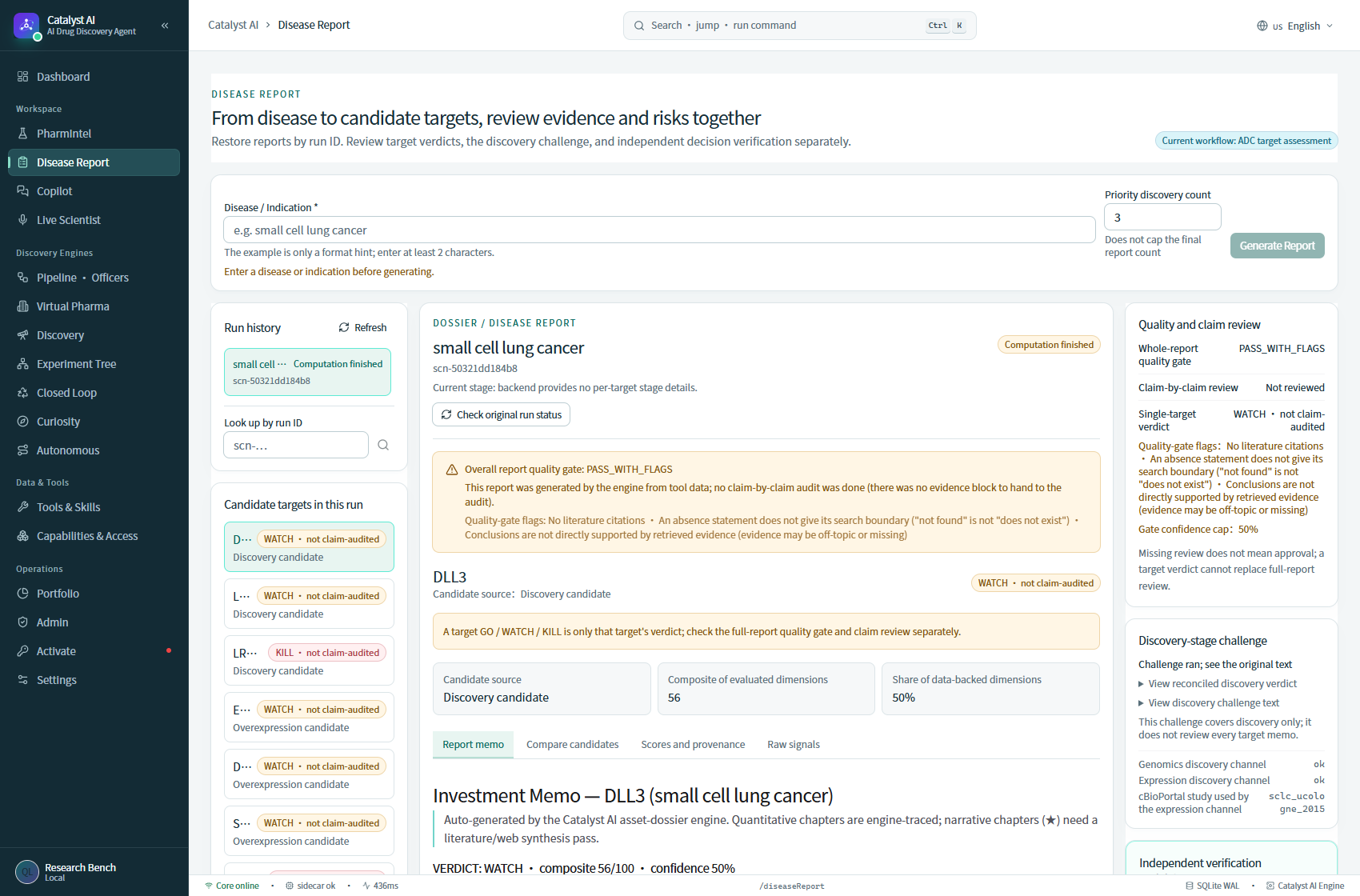
Bring drug intelligence, disease research, specialist roles and experiment planning into one research context. Work through questions with a research Copilot and real-time scientist, with traceable outputs your team can review

Start with one real research question and agreed review criteria

RESEARCH BRIEFEGFR / C797S

EXCERPT FROM AN EXISTING RESEARCH REPORT

EGFR-C797S
Candidate design & validation planning

Which assumptions still need experimental evidence?

Geometric feasibility does not establish a stable ternary complex or effective target degradation. The report separates computational findings from the experiments still needed

START WITH THE DECISION YOUR TEAM NEEDS TO MAKE

Built for the next project review,
pipeline discussion and experiment

Choose the research question first. Then agree the evidence, deliverable and review process that will help your team move forward

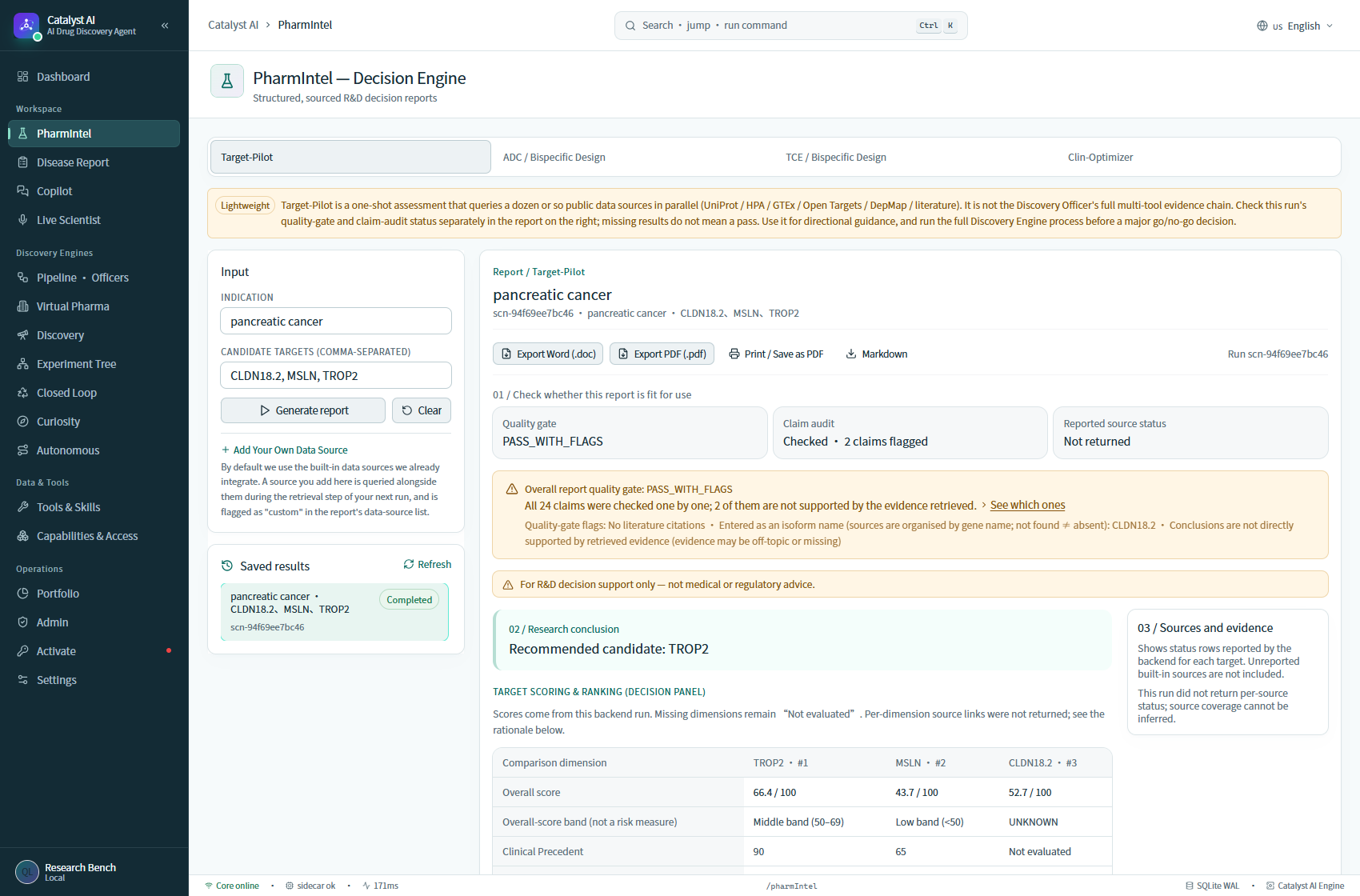
Advance the target, pause, or gather more evidence?

What you bring
Target, indication and proposed modality
What the review examines
Supporting and opposing evidence, competing programs, differentiation hypotheses and translational risks
What your team receives
A target-assessment brief, competitive landscape and evidence-gap checklist for the project review

INSPECT A RESEARCH DELIVERABLE

Research material your team
can question, line by line

An excerpt from an existing EGFR-C797S computational research report. It makes the research question, analytical basis, unresolved issues and proposed validation visible together

EXISTING REPORT EXCERPT · COMPUTATIONAL RESEARCHEGFR-C797S / DCAF1
01Research question
Which assumptions in the degrader-design direction still need validation?
02Analytical basis
The report compares candidate designs and records computational geometry assessments, separating computational clues from experimental evidence
03Still unresolved
Geometric reach and the absence of obvious clashes do not establish complex stability, cooperative binding or effective target degradation
04Proposed validation
The report identifies follow-up questions around degradation comparisons, pathway readouts and DCAF1 dependence

THE FUNCTIONS OF AN AI VIRTUAL PHARMA

Six core functions,
one shared research question

CatalystAgent connects information gathering, specialist analysis and research execution around a shared question. Your team reviews the resulting material and decides how to move forward

01

Drug intelligence

Start with
A target, indication or candidate direction
Review or receive
Competitive and R&D context, relevant sources and research reports
02

Disease reports

Start with
A disease question, relevant mechanisms and research scope
Review or receive
A structured review of disease mechanisms, related targets and research directions
03

Specialist role collaboration

Start with
A research objective and the specialist questions it raises
Review or receive
Research tasks organized by relevant roles, analytical rationale and questions for review
04

Experiment planning

Start with
A hypothesis, existing findings and experimental constraints
Review or receive
A validation brief covering controls, readouts and decision criteria
05

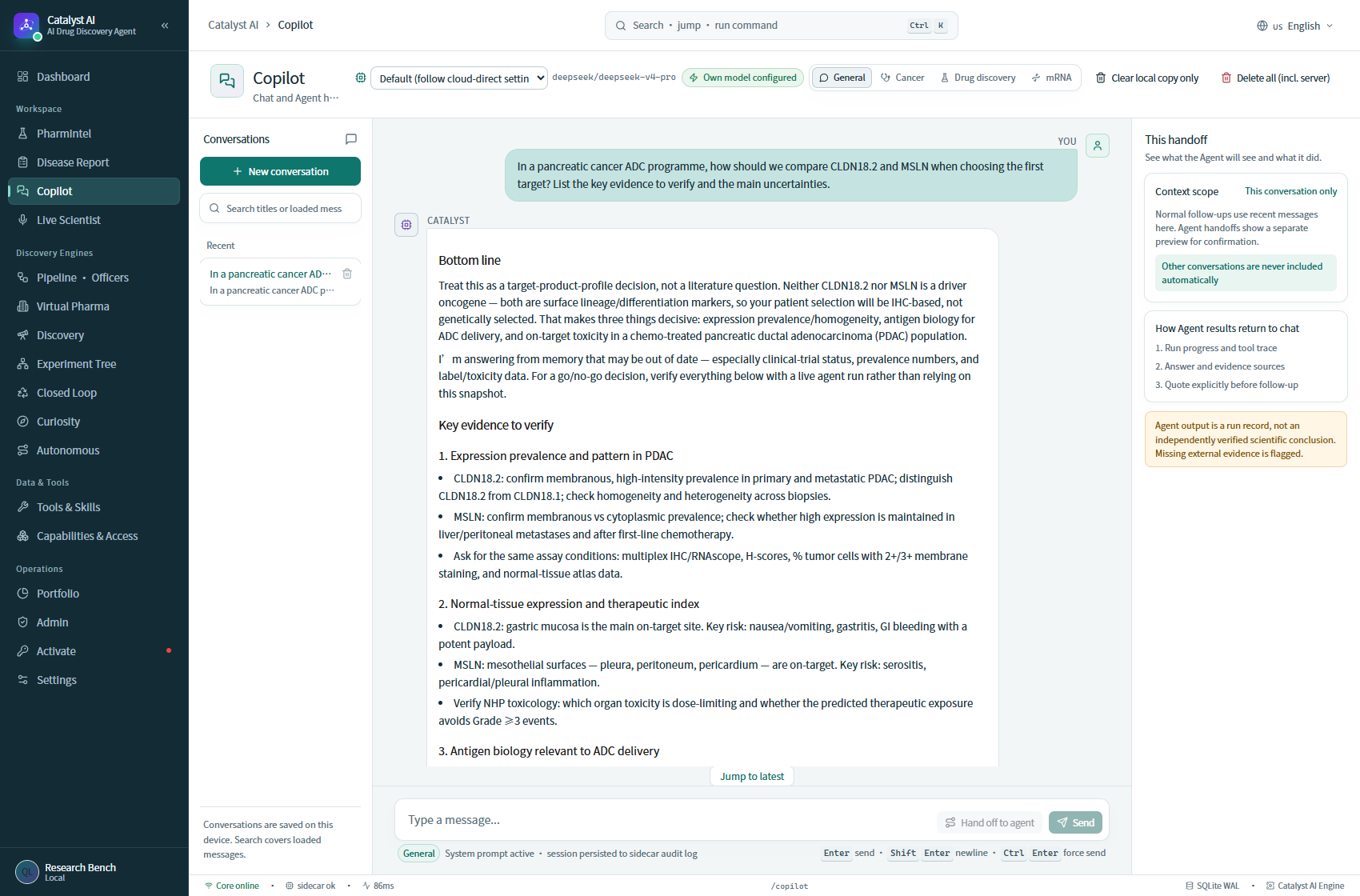
Research Copilot

Start with
Research questions, source material and follow-up questions
Review or receive
Contextual explanations, comparisons and directions for further checking
06

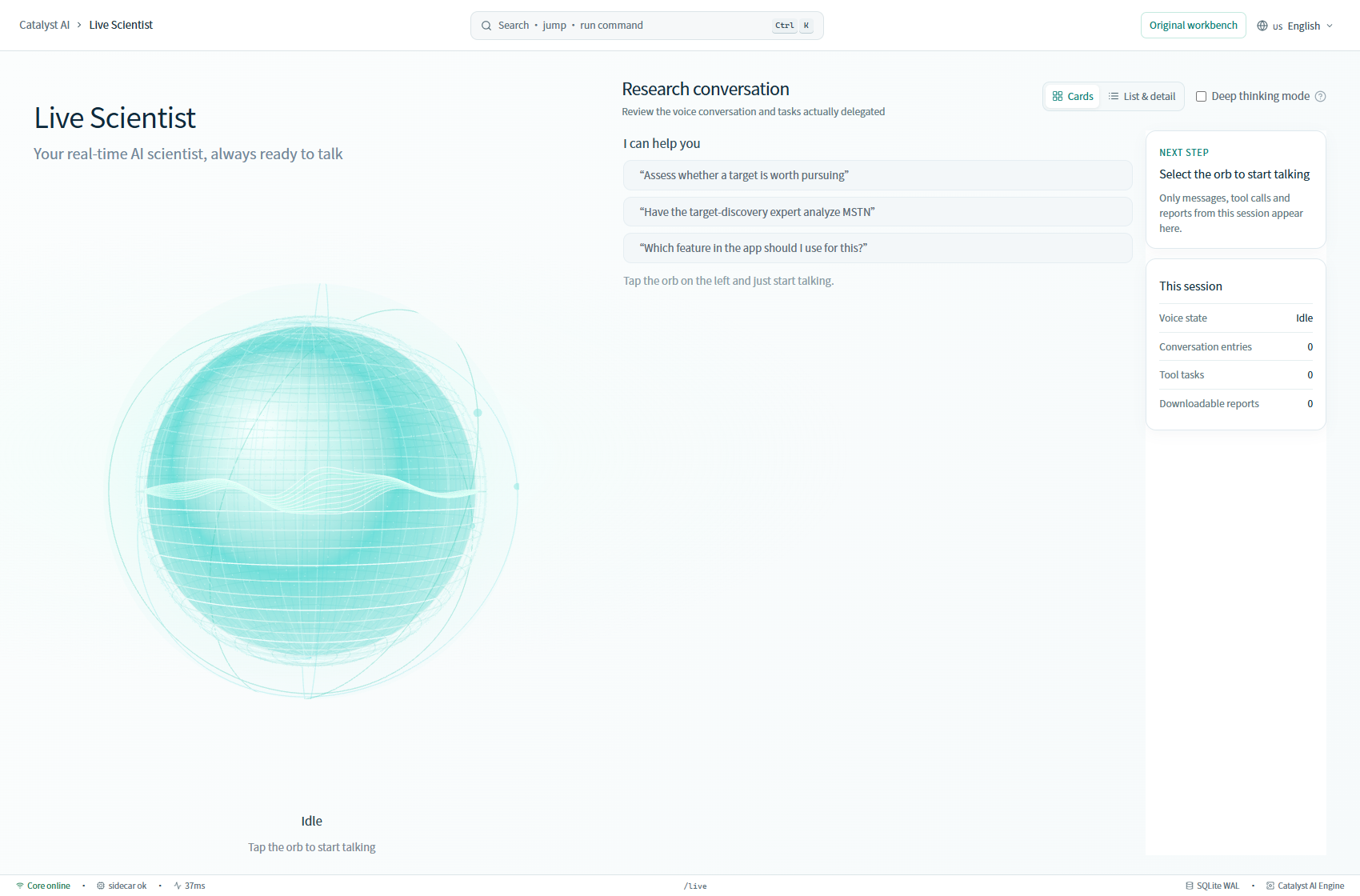
Real-time scientist

Start with
A research task to advance and instructions within the session
Review or receive
Execution activity, intermediate results and research questions needing attention

A SHARED RESEARCH PROCESS

Keep the question, evidence
and next step connected

Move through a structured research process. Keep the evidence, the reasoning and the next decision connected

  1. 01

    Frame the question

    Set the target, disease context, constraints and the decision your team needs to make

  2. 02

    Build the evidence

    Combine configured sources and scientific tools. Examine support, counterevidence and uncertainty

  3. 03

    Compare & challenge

    Evaluate candidate directions and surface the assumptions that could change the outcome

  4. 04

    Plan the next experiment

    Prepare a validation brief with the hypothesis, controls, readouts and decision criteria

RESEARCH CAPABILITIES INSIDE CatalystAgent

From molecular design
to cellular response

Our research extends the AI virtual pharma at two connected levels: multi-target molecular generation and virtual-cell modeling. Both programs are under development and ongoing validation

CatalystStar / MULTI-TARGET MOLECULAR MODEL

Designing across multiple targets

Research into native joint generation of complete multi-target peptide molecules, exploring target activity profiles and functional balance within a unified design objective

Potential application: investigate coordinated target strategies and compare molecular directions before choosing what to validate experimentally

CatalystCell / VIRTUAL CELL

Study how cells respond to change

Cell world models explore cell states, perturbations and responses. This research module aims to connect mechanistic hypotheses with experimental prioritization

Potential application: examine response hypotheses and identify which observations or experiments would help distinguish them

A PRACTICAL PATH TO EVALUATION

Use one real task to assess
the value for your R&D workflow

Choose a task your team knows well. Agree the materials, deliverables and review approach, then have your scientists assess the results before defining deployment and partnership scope

  1. 01

    Choose the use case

    Define the question, intended users and a non-confidential starting point

  2. 02

    Agree the baseline

    Specify permitted data, required outputs and the comparison with your current process

  3. 03

    Run a bounded pilot

    Evaluate an agreed configuration, with review checkpoints and scientific oversight

  4. 04

    Review & plan adoption

    Review the evidence, gaps and integration work before agreeing the next stage

Four questions for the pilot review

  • Can the evidence be checked? Locate sources for key claims, counterevidence and gaps
  • Does it help with the next decision? Compare directions consistently and make validation needs specific
  • Can the team use the deliverable? Assess its fit with existing review and handover requirements
  • Is the effort acceptable? Record preparation, review, configuration and integration work against the current process

WAYS TO WORK TOGETHER

Choose the partnership
that fits your team

Start from your research goals and technical requirements. Source-code licensing, custom development and local deployment can be discussed individually or together

01 /

Source-code licensing

For teams building long-term internal R&D capabilities

Discuss access to agreed source components and the rights needed for internal adaptation. Code scope, modification, redistribution and IP rights are defined in the agreement

Discuss a partnership
02 /

Custom development

For teams with specialized workflows and integration needs

Align scientific workflows, reports, interfaces and integrations with your use case. Define deliverables, milestones and acceptance criteria together

Discuss a partnership
03 /

Local deployment

For teams with specific infrastructure and data-boundary requirements

Assess installation, model access, data sources and operational handover in your environment. Actual data flows depend on the agreed configuration

Discuss a partnership

Pricing is discussed according to pilot scope, deployment configuration and service requirements

BUILT FOR YOUR RESEARCH CONTEXT

Your workflow.
Your deployment decisions

Discuss local-first deployment, model configuration and data-source access with our team. Data flows depend on the models, sources and deployment you choose

  • 01Deployment & infrastructure
  • 02Model & data-source configuration
  • 03Team review & delivery requirements
Talk to our team

A few important questions

What is an AI virtual pharma?

CatalystAgent organizes research tasks around coordinated scientific roles, evidence, tools and decision review. It supports pharma and biotech teams in planning and evaluating R&D work

Can we use our own models and data?

Configuration options depend on your deployment and available integrations. We assess model access, licensing, data flows and technical requirements with your team before agreeing a scope

How do we start an evaluation?

Choose a concrete research question and book a product demo. We can define a bounded pilot, the current-process baseline and agreed acceptance criteria before discussing a wider rollout

How are data and intellectual property handled?

Data access, processing, retention, model use, research outputs and intellectual-property rights are defined in the contract and technical scope. Source-code cooperation does not imply a blanket public open-source license

What integration and support are included?

Interfaces, data connectors, installation, training, handover and ongoing support are scoped for each engagement. Service levels and responsibilities are agreed explicitly rather than assumed

How do we assess the research models?

Agree the research question, datasets, baseline, metrics and limitations for a specific evaluation
BRING ONE RESEARCH QUESTION

What decision does
your team need to make next?

Start with a target, disease research question or experiment-planning challenge. We’ll discuss the deliverable, review criteria and an appropriate pilot scope

Evaluate a research questioninfo@catalystai.bio

Talk to CatalystAI

Tell us your research area, project stage and what you would like to evaluate

info@catalystai.bio